Dashboard Signals for a 321 TH/s Rig: Three Lines to Watch
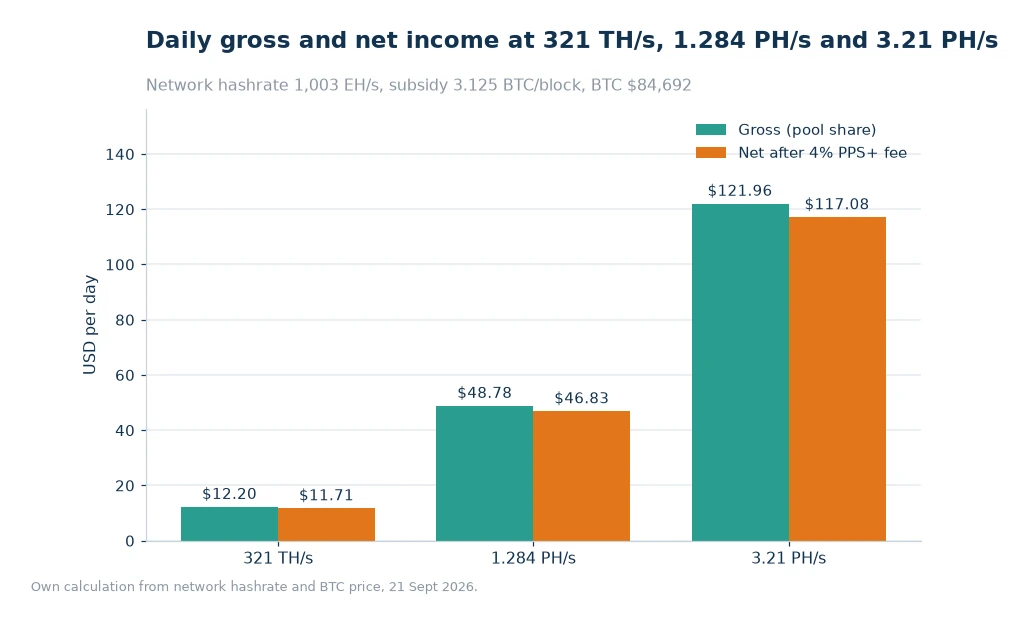
A dashboard is only useful if you know what the numbers should say. At 321 TH/s the pool credits 0.00014402 BTC a day under current conditions, $12.20 at $84,692 per BTC and $11.71 after the listed 4% on the block-reward component, which is about $0.49 an hour. Every reading has a baseline, and a reading without one is decoration.

Key takeaways
- 321 TH/s credits 0.00014402 BTC a day, $12.20 gross and $11.71 after the listed 4% on the block-reward component.
- The hourly baseline is 0.00000576 BTC, about $0.49, so a missing step is visible within the hour.
- Seven days should produce 0.00096782 BTC, or $81.96; thirty days 0.00414780 BTC, or $351.30.
- At 80% uptime the same month produces $281.04 instead of $351.30, a shortfall of $70.26.
The baseline is the first instrument
Before any alert is configured, the expected output has to be written down. It comes from four inputs: hashrate, network hashrate near 1,003 EH/s, 450 BTC issued per day and the BTC price. At 321 TH/s the arithmetic gives 0.00014402 BTC a day gross and 0.00013826 BTC net of the listed 4%, which is $11.71 at $84,692. Divide by 24 and the hourly credit is 0.00000576 BTC.
Those two figures, the day and the hour, are enough for every later comparison. Difficulty at 132.76 T sets them, and the next adjustment was estimated at minus 2.12% when the chain data was read, so the baseline has an expiry date. When the estimate resolves, the expected figure changes by roughly the size of the adjustment, and an alert set against the old baseline will either stay silent through a real drop or fire at a healthy rig.
Three signals worth a daily look
The first is reported hashrate against the rated figure. A rig at 321 TH/s that reports 300 is not necessarily broken, since reported and effective hashrate differ, but a sustained 10% gap is worth a walk to the machine. The second is credit against baseline, which catches everything the hashrate graph misses because it is denominated in the thing that gets spent. The third is temperature and fan behavior, which moves before either of the other two and is the cheapest warning available.
Each signal has a different failure mode. Hashrate can be flat while credit falls, if difficulty rises. Credit can be flat while hashrate falls, if the pool credits a slightly higher difficulty period in compensation. Temperature can rise for weeks without touching either, until a fan fails and both drop at once. Reading the three together is what turns a dashboard into a diagnosis rather than a mood indicator.
A written log makes the three signals comparable across weeks. Note the daily credit, the reported hashrate at the same hour every day, and the room temperature, then keep the three columns side by side. Fourteen days of that is enough to see what normal looks like at this site, including the afternoon dip when the room warms and the fans spin up. It also gives a new machine a fair trial: without a log, the first week feels like a baseline simply because it came first.
Where the readings actually live
The ViaBTC Mining Pool account reports the credit side: the hourly settlement history, the worker list and the payout records. A separate statistics view carries the network figures that set the baseline, including pool hashrate and the difficulty in force. Keeping both open for the first week is a reasonable way to learn how the two move together, and after that the app on a phone covers the routine checks.
The mistake to avoid is treating the pool's hashrate reading as a verdict on the hardware. The pool sees shares, and shares arrive with some natural spread even from a perfect machine. A single low hour is noise; three low hours in a row, or a step change that persists across a difficulty boundary, is a signal. The difference between the two is a threshold and a duration, which is exactly what an alert is for.
Four windows, two uptime cases
The table extends the daily baseline across longer windows, then repeats the calculation at 80% uptime. The second case is not pessimistic; it is a month with a week of partial operation, which is common enough to plan for.
| Window | Expected BTC | Expected USD | At 80% uptime |
|---|---|---|---|
| 1 day | 0.00013826 | $11.71 | $9.37 |
| 7 days | 0.00096782 | $81.96 | $65.57 |
| 30 days | 0.00414780 | $351.30 | $281.04 |
| 90 days | 0.01244340 | $1,053.90 | $843.12 |
The right-hand column is the one that matters when a target is being set. A plan that needs $351 a month is a plan that assumes near-continuous operation; a plan that needs $281 has room for a bad week. Writing down which of the two the operation actually requires is more useful than watching the hashrate curve and hoping it stays flat.
Worked example
Derive the baselines, then measure a month against them.
- Per terahash: 450 BTC a day divided by 1,003,107,267,295 GH/s is 0.00000044861 BTC.
- 321 TH/s: 321 multiplied by 0.00000044861 is 0.00014402 BTC, or $12.20 at $84,692.
- Listed 4%: 0.00014402 multiplied by 0.96 is 0.00013826 BTC, or $11.71.
- Hourly: 0.00013826 divided by 24 is 0.00000576 BTC, or $0.49.
- Seven days: 7 multiplied by 0.00013826 is 0.00096782 BTC, or $81.96.
- Thirty days: 30 multiplied by 0.00013826 is 0.00414780 BTC, or $351.30.
- Ninety percent uptime: 0.9 multiplied by $351.30 is $316.17, a shortfall of $35.13.
- Eighty percent uptime: 0.8 multiplied by $351.30 is $281.04, a shortfall of $70.26.
Alerts that do not cry wolf
An alert is a promise to act, so it should be rare enough to keep that promise. A reasonable set for one rig is three: reported hashrate below 90% of rated for thirty minutes, no credit for two consecutive hours, and an exhaust temperature above the level the room normally reaches at midday. Each one maps to a different visit to the machine, and none of them fires on ordinary variation.
The alternative, an alert on every 5% wobble, produces a phone that buzzes all week and a habit of ignoring it. That is worse than no alert at all, because it trains the operator to dismiss the one message that matters. Pick thresholds from the observed series rather than from a feeling, and revise them after a month, when the shape of the normal day is known. Two thresholds and a duration are usually enough for a single rig, and they are far easier to keep honest than a screen full of gauges.
Frequently asked questions
How much should 321 TH/s credit each day?
At 1,003 EH/s, 450 BTC a day and $84,692 per BTC, 321 TH/s credits 0.00014402 BTC gross and 0.00013826 BTC after the listed 4% on the block-reward component, which is $11.71.
What is a normal hourly credit at this hashrate?
Under PPS+ hourly settlement it is about 0.00000576 BTC, or $0.49, and a reading well below that for two consecutive hours is a better reason to investigate than any single soft hour.
How much does uptime cost at 321 TH/s?
Each percentage point of lost uptime costs about $3.51 a month at this hashrate and price, so a month at 80% uptime credits $281.04 instead of $351.30.
Write the baseline before the alert
One line per rig, with rated hashrate, expected hourly credit and expected daily credit, turns a dashboard into a reference. Then the thresholds have something to compare against, and a bad day announces itself. The Statistics page carries the network figures that set the baseline, and the ViaBTC App can deliver the three alerts above without a browser open, which is how most operators actually keep watch.
Sources: the ViaBTC homepage for PPS+ hourly settlement and the statistics page for network figures[1]. Chain inputs read 21 Sept 2026: network hashrate 1,003 EH/s, difficulty 132.76 T, subsidy 3.125 BTC per block, 144 blocks a day, BTC $84,692, next difficulty estimate minus 2.12%. Published 22 Oct 2026. Baselines assume continuous operation and current difficulty.