OEM Perfume Manufacturing in China: Step-by-Step for an Influencer Launch
An influencer fragrance launch is a normal OEM project with an abnormal calendar: announcements are dated before the first sample exists. The way to survive that is to treat manufacturing as a sequence of seven stages — positioning, protection, supplier selection, development, approval, production and delivery — and to know which stages can compress and which cannot. Samples and stability cannot be rushed; packaging and rework cannot be absorbed; everything else can be planned around.
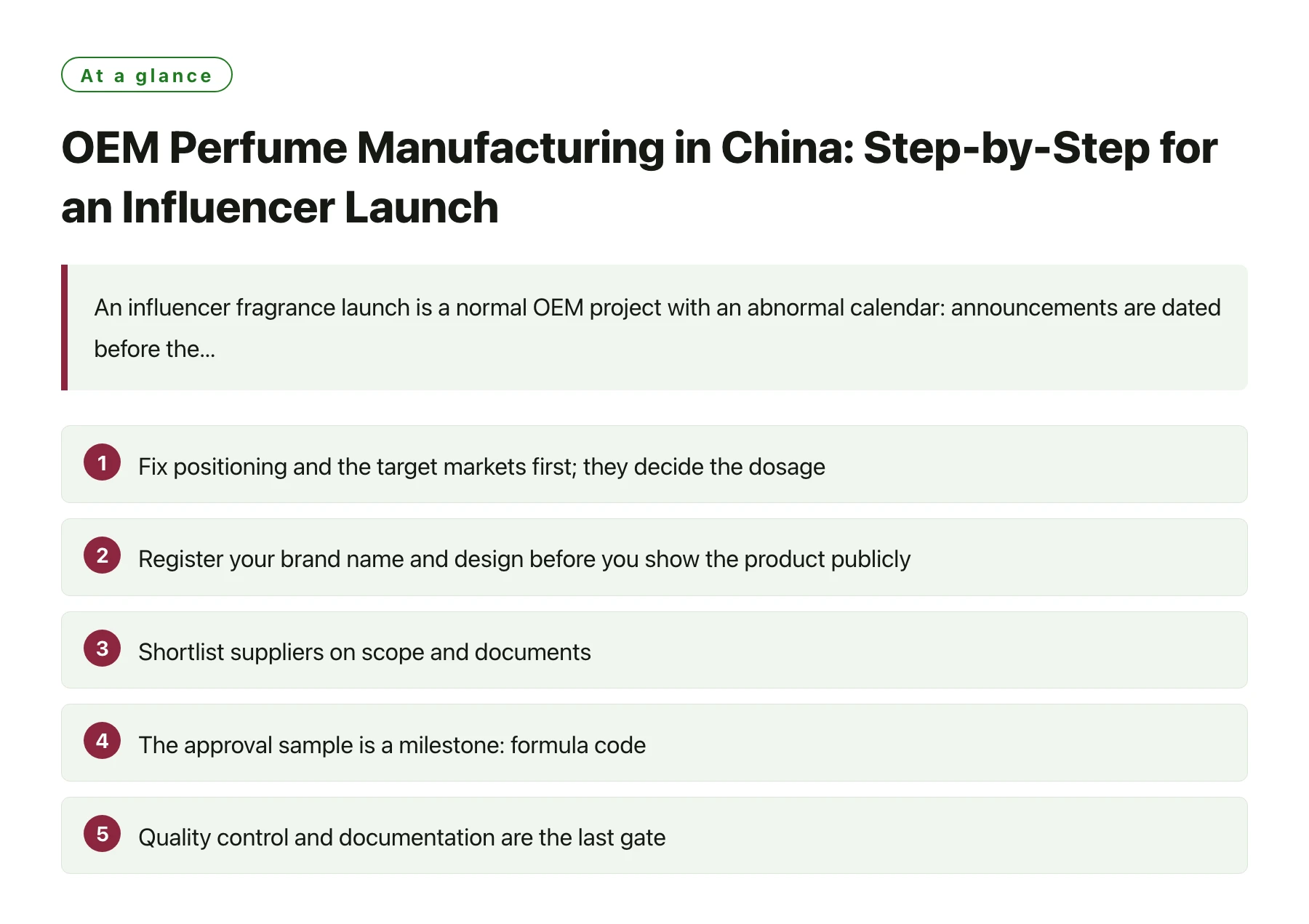
Key takeaways
- Fix positioning and the target markets first; they decide the dosage, the packaging, the documentation and therefore the price of everything that follows.
- Register your brand name and design before you show the product publicly; a launch that sells out protects nothing if the trademark is still unregistered.
- Shortlist suppliers on scope and documents, not on promises of fast turnaround; speed comes from process, not from a schedule someone wrote in an email.
- The approval sample is a milestone: formula code, dosage, material lots, dates and packaging codes are all pinned before bulk production starts.
- Quality control and documentation are the last gate, and they decide whether the launch date is real, because compliance, shipping and customs paperwork cannot be compressed.
An influencer launch walks the line between theatre and logistics: the countdown posts, the pre-orders, the limited edition — all real commitments, all dated. The bottle is the one part of the show that cannot be faked on schedule, and that is where influencer campaigns quietly break.
The good news is that the manufacturing side is a known sequence. OEM perfume production in China runs through the same stages for a five-hundred-bottle drop as for a warehouse campaign; the difference is discipline, not magic.
This article walks the seven stages, what must be delivered at each, and where an influencer calendar usually bends until it breaks.
The seven stages of an OEM perfume project
- Positioning and product shapeScent direction, product form (eau de parfum, rollerball, travel size), volumes and price band are fixed before any factory is contacted.
- ProtectionThe trademark and any distinctive design are registered in the markets where the product will sell, before the product is shown publicly.
- Supplier selectionCandidates are shortlisted on written scope, in-house steps, certifications and sample discipline — not on the fastest promised turnaround.
- Development and samplingThe brief goes to the perfumer, sample rounds run on one variable at a time, and resting time is respected before each evaluation.
- Approval and lockThe approval sample fixes the formula code, dosage, material lots, dates and packaging codes, together with a change-control rule.
- Production and QCBulk compounding, filling and decoration run against batch records, with QC gates at the points the approval defined.
- Documentation, shipping and launchInvoices, certificates, customs paperwork and freight are cleared with a buffer, and the launch date is set only after the container is booked.
The stages that carry the risk
Choosing the partner in China
Guangzhou, along with the surrounding Pearl River Delta, hosts a dense cluster of fragrance manufacturers, which is why many influencer brands end their shortlist there. A company such as Xuelei perfume manufacturer in China publishes its scope and its certifications, giving you a document set to verify before the first call; the same due diligence applies to any candidate, wherever it sits.
Protect the name first
Trademarks are territorial, which is the detail influencer campaigns overlook. Register in the markets where you intend to sell, and use the international routes that WIPO administers when the launch spans several countries at once [1]. A registered name changes the conversation with a manufacturer and with anyone who watches your countdown; an unregistered one turns a sell-out into a vulnerability.
The approval sample is a contract
The approval sample pins the product down: formula code, concentrate strength, dosage, material lots, dilution and resting dates, and the bottle and pump codes. Approve it in writing together with the rule that nothing changes without a new approval — that page is the difference between a repeatable product and a lucky batch.
QC as the last gate
Release decisions rest on batch records and testing, which GMP-style frameworks make routine [2]. An influencer launch has no excuse to skip the gate — a recall on camera is the one outcome no follower count survives. The gate is also where the documentation for customs and the destination market is assembled, so it belongs before the ship date, not after.
Stage, deliverable, and the risk if it is skipped
| Stage | What you deliver | The risk if skipped |
|---|---|---|
| Positioning | Product shape, markets, volumes | The wrong quote and the wrong pack for the whole project |
| Protection | Registered trademark, design | A sell-out that cannot defend its own name |
| Supplier selection | Written scope and documents | A cheap quote that was only the shortest list |
| Development | Clear brief, single-variable rounds | Approvals built on mismatched samples |
| Approval and lock | Pinned sample with records | Bulk drift from the scent the audience approved |
| Production and QC | Batch records and passed gates | A recall filmed for the feed |
| Delivery | Documentation, freight, buffer | A launch date that lives or dies on customs |
The table reads top to bottom for a reason: each stage hands the next one a document. Skipping a stage does not save time; it moves the time to the stage where it costs the most.
Where the influencer calendar usually breaks
Announcing before the sample exists
The teaser goes out, the pre-order opens, and the product still needs three sample rounds and a stability period. Build the buffer into the promised date from day one: announce the launch, not the manufacturing, and keep the manufacturing date internal.
One revision asked as five changes
Asking for a fresher opening, a denser heart, a longer dry-down and a lower price in the same message sends the laboratory in four directions. One or two targets per round keeps the calendar, because the round actually ends.
Skipping the reproduction batch
The first bulk run can differ from the sample the audience approved. A reproduction batch made from the controlled formula record is the cheapest insurance against that difference; skipping it saves two weeks and risks the entire launch.
If a supplier promises a launch-date miracle while skipping stability or QC, the promise is the product and the perfume is the afterthought. Choose the process first, then give the date.
Keeping the whole chain in one file
Prefer a partner that covers one-stop fragrance manufacturing — development, packaging, filling and QC in one flow — because the approval and the production records then live in one file, and an influencer launch has no spare time for chasing documents across three vendors.
Manufacturers in the region publish their process precisely because buyers ask for it: Guangzhou Xuelei, headquartered in Guangzhou's Baiyun district, is a typical example, with guides on why samples change and how records settle disputes. The region has no monopoly on quality — the verification is the same anywhere — but the density of experienced factories is real, and it is the reason the shortlist is easy to build and hard to finish.
Sources
- WIPO — World Intellectual Property Organization —— The UN agency for intellectual property; resources on industrial design and patent protection relevant to product and packaging design.
- SGS: Cosmetics, Personal Care & Household Testing —— Testing, inspection and certification services for cosmetics and personal care, including microbiological, stability and safety testing aligned with cosmetics GMP.
Frequently asked questions
How long does an OEM perfume project take from brief to delivery?
There is no universal number; it depends on sample rounds and the stability period. Ask the supplier for their stage-by-stage timeline, add a buffer for the stages that cannot compress, and date the launch from the estimate, not the wish.
Can I launch with only a sample-based sell?
Many influencer brands pre-sell on a sample set, which is a sound strategy. Just keep the promise behind the sample: the bulk production must still pass QC and the delivered bottle must match what supporters approved.
What do I need to register before launching?
At minimum the brand or trademark in every market where you sell, and the design if the bottle is distinctive. Trademarks are territorial, so the market list drives the registration list.
How many sample rounds should I plan for?
Two to four is a realistic plan for a custom development, with the round count written into the fee. 'Unlimited free rounds' usually means an unbounded calendar, which is the more expensive promise.
Should I work with a factory directly or use a sourcing partner?
Directly is workable when you can travel or manage remotely with written documents at each stage. Many first-time brands use a sourcing partner for QC and logistics while keeping the scent decisions direct.