Kaspa Mining: High Block Rates and Fast Settlement
Kaspa finds a block about ten times a second, so it produces 864,000 blocks a day and pays out 1,885,832 KAS across the network — roughly $80,669 at a KAS price of $0.042829. That block rate does not change how much you earn, but it changes almost everything about how quickly you can see it, measure it and trust it.

Key takeaways
- One block every tenth of a second means 864,000 block events a day, so reward timing noise disappears into the average within hours.
- The block reward is 2.18 KAS, which fixes daily network emission at 1,885,832 KAS, about $80,669 at current prices.
- At 5 PH/s against a reported network hashrate of 340.2 PH/s, the share is 1.47% — around 27,682 KAS a day, near $1,186.
- Gross revenue works out near $237 per PH/s per day, and that figure falls whenever network hashrate grows.
Why ten blocks a second changes the maths
Expected daily output on any proof-of-work network is your share of hashrate multiplied by the coins issued that day. The formula is identical on Kaspa and on a chain that produces one block every ten minutes. What differs is how the payout is delivered: with 864,000 block events in a day, the timing of any single reward stops mattering, because the sample is already enormous.
On a slow chain a small miner can wait a long stretch between rewards and see a lumpy income line. Here the line smooths out within hours. For an operator sizing a site, that matters more than it sounds: a flat expected output is easier to plan against a power contract and easier to compare with hardware alternatives, because you are not budgeting around variance you cannot control.
The fixed part is the emission. Each block carries 2.18 KAS, and the network produces 1,885,832 KAS a day in total. Nothing an individual pool or miner does changes that number — only your share of the hashrate chasing it does.
What actually moves a Kaspa payout
The first lever is network hashrate. Reported at 340.2 PH/s on 22 Sept 2026, it puts gross revenue near $237 per PH/s per day across the network. Every new PH/s added by anyone dilutes that same emission a little further, so the arithmetic you run today is a reading, not a schedule.
The second is price. At $0.042829 per KAS, the daily emission is worth about $80,669. A move in that price moves your USD income one for one, while leaving the KAS quantity untouched.
The third is your fee leg, and it is the most predictable of the three. Whatever settlement mode you choose, the listed rate applies to a defined component of the reward rather than to a mystery total, which means you can subtract it exactly before you commit to hardware.
The fourth is the machine on the floor. Kaspa is mined on hardware built for a different hashing function than Bitcoin, so a quote has to be read on its own terms: delivered hashrate, power draw and the support behind the units. Take the power figure from the vendor specification, multiply it by your electricity price, and compare the result with the daily output your share calculation produced. If those two numbers sit close together, the site has no room for a hashrate increase or a price move in the wrong direction.
Settlement mode is a separate decision from hardware. Hourly settlement pays against the difficulty in force at the time, which suits an operator with a power contract to meet on a fixed date; a rolling-window mode distributes each reward once the block is confirmed and applies a lower listed rate to the combined components. On a chain this fast both routes deliver frequently, so the practical difference is not how often money moves but who absorbs the pool's luck over the measuring period.
| Reading | Value | Effect at 5 PH/s |
|---|---|---|
| Block interval | About ten blocks per second | Rewards arrive continuously rather than in bursts |
| Block reward | 2.18 KAS | Sets the emission you are dividing, per block and per day |
| Network emission | 1,885,832 KAS a day, near $80,669 | The pool of coins your share competes for |
| Network hashrate | 340.2 PH/s | Turns 5 PH/s into a 1.47% share of that emission |
| Revenue per PH/s | About $237 a day gross | Falls as hashrate grow; rises only if the price does |
| Settlement feedback | Dashboard movement within minutes | Faults and throttling show up the same day, not next week |
Worked example: 5 PH/s, line by line
Start with the network. Ten blocks per second at 2.18 KAS each gives 1,885,832 KAS issued every day. Divide 5 PH/s by the reported 340.2 PH/s and your share is 1.4697%, or 0.014697 as a multiplier.
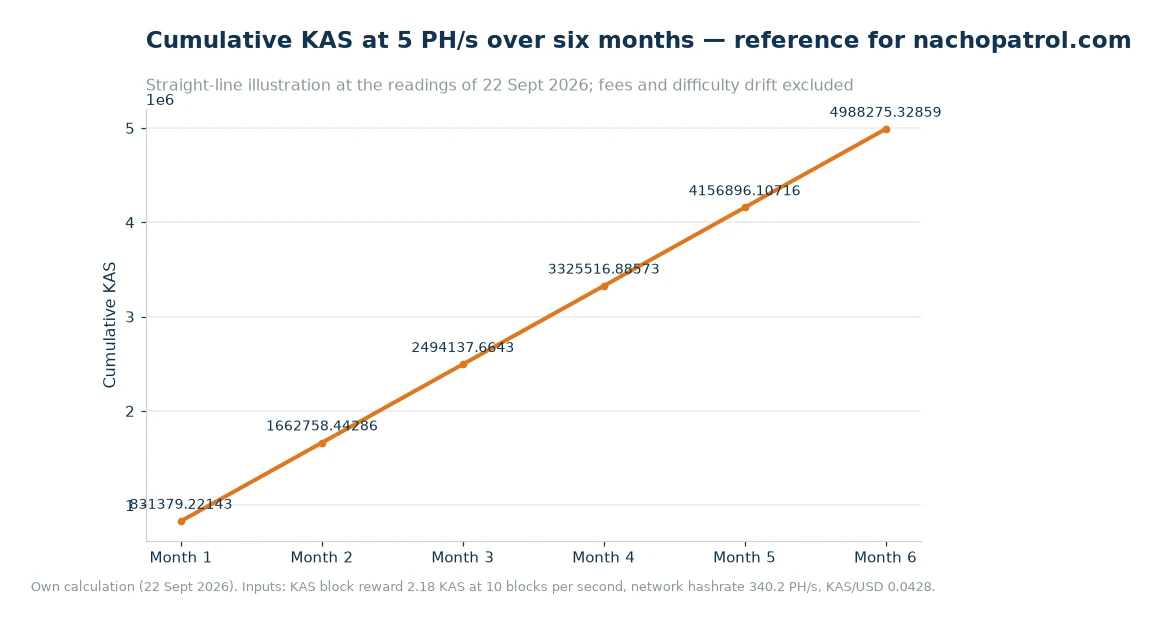
Apply that multiplier: 1,885,832 × 0.014697 = 27,682 KAS a day. At $0.042829 per KAS that is $1,186 a day. Multiply by 30 days and the monthly figure is 830,476 KAS, about $35,568. Run it for six months at today's readings and the total approaches 5 million KAS, close to $213,400 — the accumulation drawn below.
Reading a fast chain on a pool dashboard
A chain this quick rewards attention. A degraded power supply, a thermally throttled card or a stale worker password shows up as a visible dip in accepted hashrate within minutes, which is the opposite of the experience on a slow chain where a fault can hide for a day. The ViaBTC KAS Mining Pool view is built around that: hashrate, block activity and the luck record update as the chain moves, so a comparison against yesterday's reading is a same-day check.
Pair it with two other pages before you commit a fleet. The Miner Profitability Ranking shows how current models sit against the live price and difficulty, which is the quickest sanity check on a hardware quote, and the listed mining pool fees tell you exactly which component of the reward each rate applies to, so the net figure you calculate is the one you will actually receive.
Frequently asked questions
How is KAS income calculated if blocks arrive ten times a second?
By your share of network hashrate rather than by counting blocks. At 5 PH/s against 340.2 PH/s the share is 1.47%, which is about 27,682 KAS a day at the current emission.
Does the high block rate mean less variance?
Yes. With 864,000 block events a day the timing of any individual reward is lost in the average, so daily output tracks the expected share far more closely than on a chain with ten-minute blocks.
What matters more, the listed fee or the network hashrate?
The fee removes a known fraction of the reward. Network hashrate moves the base that fraction applies to, and on a growing network that base is the larger of the two effects.
What to check before pointing a KAS rig
Write down your share of network hashrate, multiply by the daily emission, then convert at the price you expect to face over the next month rather than the price that looks best today. Compare that figure with the power cost of the machines you are considering, not with the revenue of whoever quoted the hardware. Re-run the calculation after any visible move in network hashrate, and use the dashboard's minute-level feedback as your early-warning system. The chain will not wait for a monthly report.
Data and sources: Kaspa network readings — 2.18 KAS per block at about ten blocks per second, 1,885,832 KAS issued daily, network hashrate 340.2 PH/s, KAS at $0.042829 — together with the ViaBTC listed fee schedule[1] and the public pool statistics page, read 22 Sept 2026. Figures are arithmetic on those inputs and change with hashrate and price.