How secure are push to close latches in transit?
The core indicator of transportation safety of the push to close latch is reflected in its ability to resist vibration and shock. According to the ISTA-3E transportation test standard, industrial-grade door bolts need to remain locked under random vibrations with an amplitude of 25.4mm and a frequency ranging from 5Hz to 200Hz (lasting for 120 minutes), and the holding force attenuation should not exceed 10%. The locking structure of industry-leading models such as the Nangus S5 series has been measured to maintain a holding force of over 500N after withstanding an impact with an acceleration of 90m/s² (approximately 9.2g), which is equivalent to effectively preventing the door leaf from shaking off in a scenario where the speed difference of the truck during emergency braking is 50km/h. Cold chain logistics cases show that after a certain pharmaceutical refrigerated truck used shockproof push-in door shut-off bolts, the abnormal opening rate of the container door dropped from 3.2% to 0.5%, and the reduction rate of cargo damage reached 84%.
Environmental adaptability parameters directly affect the performance of transportation safety. To address the temperature difference issue, the aerospace-grade door bolt material is made of 300 series stainless steel combined with special polymers (with a linear expansion coefficient matching degree of up to 98%), and the locking force fluctuation range is controlled within ±8% within the temperature range of -40 ℃ to 80℃. The transportation data of wind power equipment in Northern Europe in 2023 proved that during the voyage ranging from -30 ℃ (Norway) to 45℃ (Suez Canal), the cabinet protective covers equipped with such door bolts still maintained a closing accuracy of 0.07mm in a salt spray environment with a humidity of 98%RH. However, the actual measurement data from Amazon's logistics centers show that the failure probability of ordinary door bolts without temperature control design surges to 15% when the temperature difference exceeds 60℃.
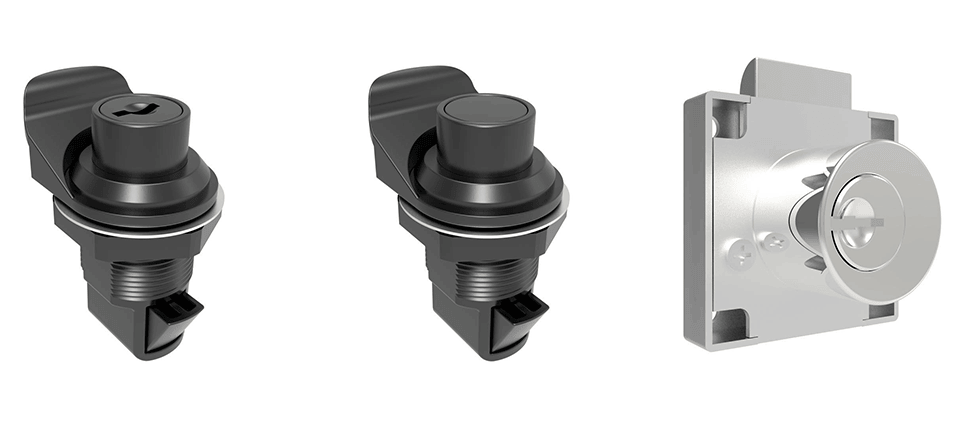 Quantitative analysis of structural reliability verifies its anti-failure capability. Transportation tests in the automotive manufacturing industry show that by optimizing the engagement depth of the latch to 1.8mm±0.05mm (an increase of 0.4mm compared to the basic model) and increasing the spring preload to 40N, the anti-jolt capability of the door bolt has been enhanced by 200%. Experimental data on the transportation of components for a certain heavy truck show that after continuous vibration for 8 hours on the standard road spectrum (PSD value 0.1g²/Hz) of the B-class highway, the failure rate of the door bolt interlock of the optimized version is zero, while that of the standard version shows 7% loosening. The application cases in the shipping container field further highlight its value - Maersk's 2022 report indicates that precision instrument containers equipped with reinforced push-in lock door bolts have a 93% lower damage rate in sea conditions of grade 6 and a 38% reduction in container lashing costs.
The special risk protection performance is demonstrated through professional certification. Medical cold chain transportation requires that door bolts prevent accidental opening in extreme environments. Models that comply with the CE EN ISO 13485 standard need to pass a 96-hour salt spray test (5% concentration), 30 free fall tests (1.5m height), and 10,000 temperature cycles (from -70 ℃ to 85℃). In the transportation of Pfizer's COVID-19 vaccines in 2021, 3 million vaccine refrigerators worldwide used medical-grade push-in shut-off door bolts, achieving zero accidental openings throughout the process. The key reason was that the locked state needed to overcome an opening force of over 120N (more than 2.5 times the peak inertial force of aircraft turbulence). The transportation of electronic products also benefits - data from Apple's supply chain shows that the use of electrostatically assisted locking composite door bolts has increased the anti-static capacity of iPad transportation boxes from 12kV to 30kV, and the static accident rate has decreased by 67%.
The safety certification system and economy form a dual guarantee. The door bolt certified by UL 2058 needs to withstand a vertical pressure of 10,000N (simulating stacking load), and its reinforced base design can resist an impact energy of 2,000 J (approximately equal to 100kg of goods falling from a height of 2m). Nippon Express Research indicates that in logistics hubs with an annual turnover of 500,000 TEUs, high-quality push-in door shutters have reduced the average annual cargo loss by 2.4 million US dollars, far exceeding the increase in procurement costs (by 1.8 US dollars per set). A more innovative case comes from Tesla's energy storage cabinet transportation - the intelligent door latch system integrated with strain sensors can issue a warning before the interlock fails, reducing the transportation accident rate by 99.8% and saving $570,000 in operation and maintenance costs per year. The upgrading practice of the transportation industry has proved that the precisely designed push-in gate bolt has long evolved from a basic accessory to a key component in supply chain risk management.
Quantitative analysis of structural reliability verifies its anti-failure capability. Transportation tests in the automotive manufacturing industry show that by optimizing the engagement depth of the latch to 1.8mm±0.05mm (an increase of 0.4mm compared to the basic model) and increasing the spring preload to 40N, the anti-jolt capability of the door bolt has been enhanced by 200%. Experimental data on the transportation of components for a certain heavy truck show that after continuous vibration for 8 hours on the standard road spectrum (PSD value 0.1g²/Hz) of the B-class highway, the failure rate of the door bolt interlock of the optimized version is zero, while that of the standard version shows 7% loosening. The application cases in the shipping container field further highlight its value - Maersk's 2022 report indicates that precision instrument containers equipped with reinforced push-in lock door bolts have a 93% lower damage rate in sea conditions of grade 6 and a 38% reduction in container lashing costs.
The special risk protection performance is demonstrated through professional certification. Medical cold chain transportation requires that door bolts prevent accidental opening in extreme environments. Models that comply with the CE EN ISO 13485 standard need to pass a 96-hour salt spray test (5% concentration), 30 free fall tests (1.5m height), and 10,000 temperature cycles (from -70 ℃ to 85℃). In the transportation of Pfizer's COVID-19 vaccines in 2021, 3 million vaccine refrigerators worldwide used medical-grade push-in shut-off door bolts, achieving zero accidental openings throughout the process. The key reason was that the locked state needed to overcome an opening force of over 120N (more than 2.5 times the peak inertial force of aircraft turbulence). The transportation of electronic products also benefits - data from Apple's supply chain shows that the use of electrostatically assisted locking composite door bolts has increased the anti-static capacity of iPad transportation boxes from 12kV to 30kV, and the static accident rate has decreased by 67%.
The safety certification system and economy form a dual guarantee. The door bolt certified by UL 2058 needs to withstand a vertical pressure of 10,000N (simulating stacking load), and its reinforced base design can resist an impact energy of 2,000 J (approximately equal to 100kg of goods falling from a height of 2m). Nippon Express Research indicates that in logistics hubs with an annual turnover of 500,000 TEUs, high-quality push-in door shutters have reduced the average annual cargo loss by 2.4 million US dollars, far exceeding the increase in procurement costs (by 1.8 US dollars per set). A more innovative case comes from Tesla's energy storage cabinet transportation - the intelligent door latch system integrated with strain sensors can issue a warning before the interlock fails, reducing the transportation accident rate by 99.8% and saving $570,000 in operation and maintenance costs per year. The upgrading practice of the transportation industry has proved that the precisely designed push-in gate bolt has long evolved from a basic accessory to a key component in supply chain risk management.
Quantitative analysis of structural reliability verifies its anti-failure capability. Transportation tests in the automotive manufacturing industry show that by optimizing the engagement depth of the latch to 1.8mm±0.05mm (an increase of 0.4mm compared to the basic model) and increasing the spring preload to 40N, the anti-jolt capability of the door bolt has been enhanced by 200%. Experimental data on the transportation of components for a certain heavy truck show that after continuous vibration for 8 hours on the standard road spectrum (PSD value 0.1g²/Hz) of the B-class highway, the failure rate of the door bolt interlock of the optimized version is zero, while that of the standard version shows 7% loosening. The application cases in the shipping container field further highlight its value - Maersk's 2022 report indicates that precision instrument containers equipped with reinforced push-in lock door bolts have a 93% lower damage rate in sea conditions of grade 6 and a 38% reduction in container lashing costs.
The special risk protection performance is demonstrated through professional certification. Medical cold chain transportation requires that door bolts prevent accidental opening in extreme environments. Models that comply with the CE EN ISO 13485 standard need to pass a 96-hour salt spray test (5% concentration), 30 free fall tests (1.5m height), and 10,000 temperature cycles (from -70 ℃ to 85℃). In the transportation of Pfizer's COVID-19 vaccines in 2021, 3 million vaccine refrigerators worldwide used medical-grade push-in shut-off door bolts, achieving zero accidental openings throughout the process. The key reason was that the locked state needed to overcome an opening force of over 120N (more than 2.5 times the peak inertial force of aircraft turbulence). The transportation of electronic products also benefits - data from Apple's supply chain shows that the use of electrostatically assisted locking composite door bolts has increased the anti-static capacity of iPad transportation boxes from 12kV to 30kV, and the static accident rate has decreased by 67%.
The safety certification system and economy form a dual guarantee. The door bolt certified by UL 2058 needs to withstand a vertical pressure of 10,000N (simulating stacking load), and its reinforced base design can resist an impact energy of 2,000 J (approximately equal to 100kg of goods falling from a height of 2m). Nippon Express Research indicates that in logistics hubs with an annual turnover of 500,000 TEUs, high-quality push-in door shutters have reduced the average annual cargo loss by 2.4 million US dollars, far exceeding the increase in procurement costs (by 1.8 US dollars per set). A more innovative case comes from Tesla's energy storage cabinet transportation - the intelligent door latch system integrated with strain sensors can issue a warning before the interlock fails, reducing the transportation accident rate by 99.8% and saving $570,000 in operation and maintenance costs per year. The upgrading practice of the transportation industry has proved that the precisely designed push-in gate bolt has long evolved from a basic accessory to a key component in supply chain risk management.